
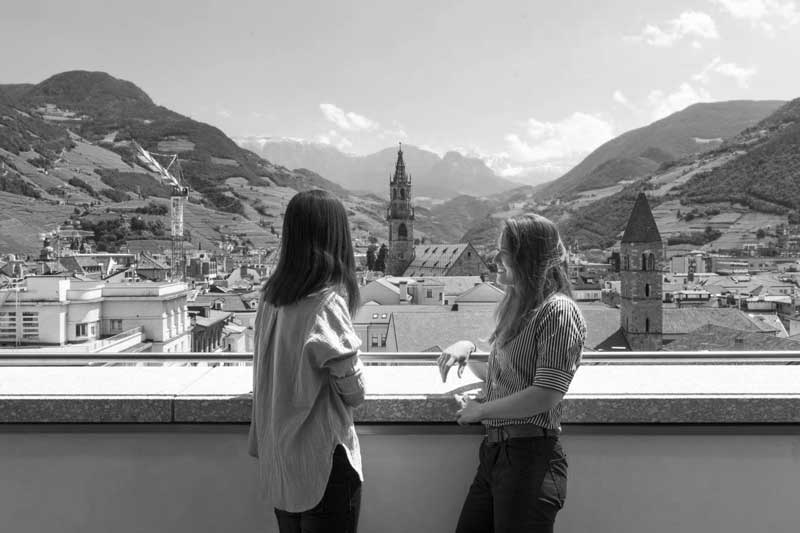
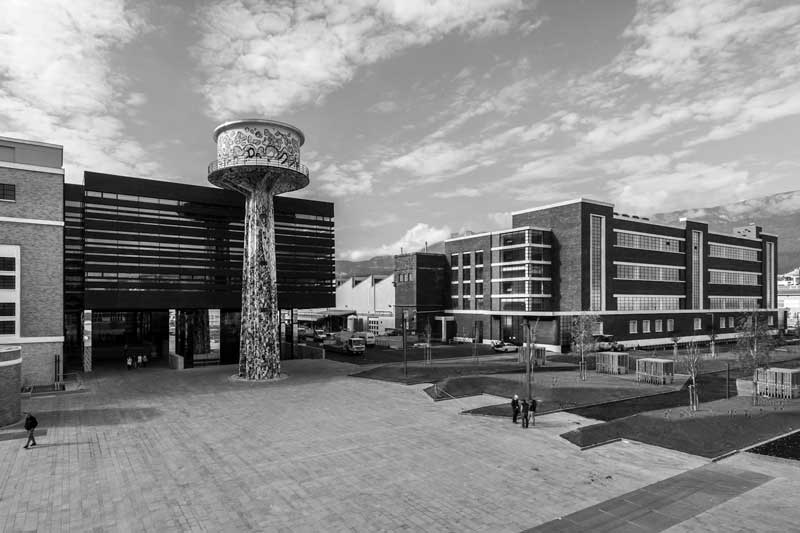
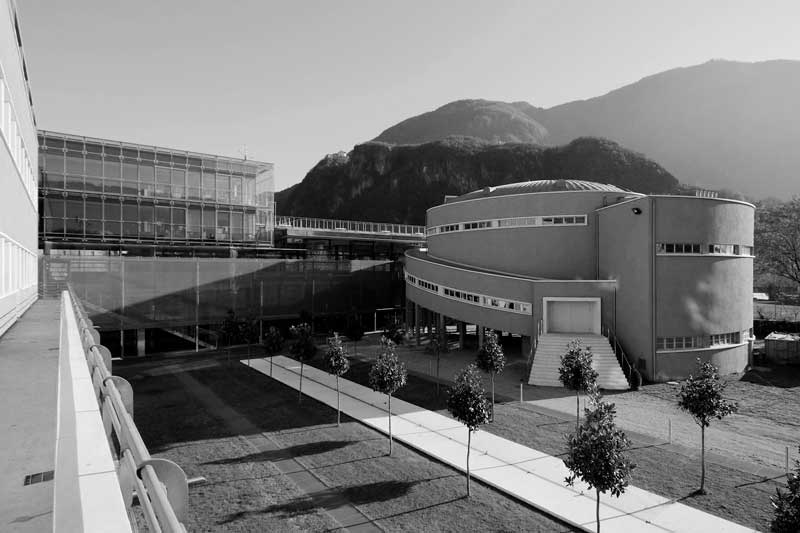
View of Bolzano from the terrace. Credits: Camilla Pizzini/unibz · NOI Techpark. Credits: Oskar De Riz/unibz · Eurac Research. Credits: Oskar De Riz/unibz
Lectures on Computational Linguistics 2026
June 15–17 2026, Bolzano
June 15-16 : Libera Università di Bolzano, NOI Techpark, Via Alessandro Volta 13/A.
June 17: Eurac Research, Viale Druso 1.
In collaboration with:


The Lectures on Computational Linguistics is an event organized yearly under the umbrella of AILC (Associazione Italiana di Linguistica Computazionale).
The 2026 edition of AILC Lectures is organized in collaboration with the Free University of Bozen-Bolzano, Faculty of Engineering (Raffaella Bernardi) and Faculty of Education (Alessandro Vietti), and Eurac Research (Luca Ducceschi). This edition is organized with a view on the impact of Computational Lingustics and Natural Language Processing for the Society.
The event is primarily addressed to graduate students, Ph.D. candidates and Master students, but welcomes all those who might be interested in the topics. Participation is free but subject to registration > (up to 150 places available) and membership to AILC. See link below.
The Lectures include:
- Three 2-hours tutorials on
- Three 2-hours hands-on laboratories
- Two Student Poster Sessions
- Two evening lectures
Program
Monday 15.06 – NOI Techpark, Seminar 2, Building A1, –1 floor
- 9:00–9:30: Welcome and opening
- 9:30–11:30: Tutorial: Developing ASR Systems for Conversational Speech Transcription and Analysis – Barbara Schuppler (TU Graz)
- 11:30-12:00: Break
- 12:00-13:30: Students Poster Session
- 13:30-15:00: Lunch Break
- 15:00–17:00: Lab I: Recognition in Spontaneous Speech – Loredana Schettino e Alessandro Vietti (Facoltà di Scienze della Formazione, UNIBZ)
- 17:00–17:30: Break
- 17:30–18:30: Evening Lecture: Small Language Models for Education – Aurélie Herbelot (Denotation UG)
- 18:30: Welcome drink
Tuesday 16.06 – NOI Techpark, Seminar 2, Building A1, –1 floor
- 9:30–11:30: Tutorial II:From Vision Language Models to Embodied AI –Elia Bruni (University of Osnabrück)
- 11:30–12:00: Break
- 12:00–13:30: Students Poster Session
- 13:30–15:00: Lunch Break
- 15:00–17:00: Lab II: Mechanistic Interpretability – Leonardo Bertolazzi (University of Trento)
- 17:00–17:30: Break
- 17:30–18:30: Evening Lecture: NLP: Where We Came From, Where We Are, Where We Are/Could Be Going – Julia Hockenmaier (University of Illinois)
- 20:00: Social Event
Wednesday 17.06 – Eurac Research, Auditorium
- 9:00–11:00: Tutorial: NLP Beyond the Standard: Dialects, Variation, and Shared Representations in Multilingual Language Models – Barbara Plank (LMU Munich)
- 11:00–11:30: Break
- 11:30–13:30: Lab III: Data Curation and Speech-to-Text Fine-Tuning for Minority Languages – Egon Stemle e Luca Ducceschi (Eurac Research)
- 13:30–15:00: Lunch Break
Student’s Presentation
Students are invited to present their ongoing research during two Student Sessions. Interested participants are required to submit a 500-word abstract in English to ailc.lectures@gmail.com within the deadline of the 16th of May. Please, specify in the subject: “Abstract Submission LCL2026“. Acceptance notices will be sent by the 23rd of May.
Registration
Registration closes on May 27th or earlier, if the max number of places is reached. Here is the link to register.
Scientific Committee
Raffaella Bernardi (Free University of Bozen-Bolzano)
Tommaso Caselli (University of Groningen)
Francesco Cutugno (University of Napoli Federico II)
Felice Dell’Orletta (Istituto di Linguistica Computazionale CNR – Pisa)
Elisabetta Jezek (University of Pavia)
Local Organisers
Raffaella Bernardi (Faculty of Engineering, Free University of Bozen-Bolzano)
Alessandro Vietti (Faculty of Education, Free University of Bozen-Bolzano)
Luca Ducceschi (Eurac Research)
Organising Committee
Simone Ciciliano (Faculty of Engineering, unibz)
Domenico De Cristofaro (Faculty of Education, unibz)
Umberto Domanti (Faculty of Engineering, unibz)
Loredana Schettino (Faculty of Education, unibz)
Egon Stemle (Eurac Research)
Contact: ailc.lectures@gmail.com
Supported by the FESR:
